
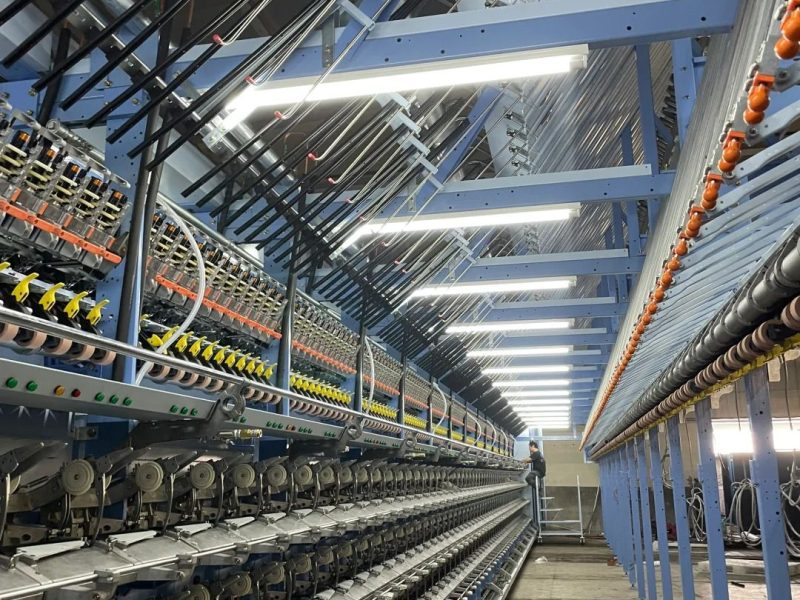
Setting up a light gauge steel production facility involves much more than purchasing a roll forming machine and starting production. Profile sections, target capacity, machine configuration, raw-material flow, factory layout, electrical infrastructure, storage and logistics should all be considered as parts of the same production system.
A properly planned facility should not only meet current manufacturing requirements. It should also allow the business to increase production volume or expand its product range as demand develops.
For this reason, the first question should not simply be “Which machine should we buy?” but rather “What type of production operation are we planning to build?”
Define the Profiles You Plan to Produce
The first step is to determine the product range.
Profile sections and technical characteristics used in light gauge steel construction can vary according to structural requirements. The facility should therefore be planned around the profile groups it is expected to manufacture.
MAICON roll forming machines are available as individual 60, 90 and 140 mm models as well as a Multi model designed for a broader range of section requirements.
A facility that consistently manufactures one profile group may require a different machine configuration from a company serving different projects and customers.
Future product diversity should therefore be considered alongside the current order portfolio.
How Should Production Capacity Be Planned?
Maximum hourly machine capacity is important, but it does not represent the full production capacity of a facility.
MAICON roll forming machines can process up to 800 metres of straight profile per hour and up to 350 metres per hour for wall, roof, truss and ceiling components.
Practical capacity planning should also consider:
- number of shifts per day,
- average monthly project volume,
- profile consumption per project,
- frequency of production changes,
- raw-material lead times,
- planned maintenance and downtime,
- packaging and dispatch operations.
For this reason, theoretical machine output and practical monthly factory capacity should be treated as different measures.
How Should the Factory Layout Be Planned?
A good production facility is not simply a building with enough floor area. Material should be able to move through the factory efficiently without unnecessary handling.
A typical workflow may be organised as:
raw-material receiving → coil storage → uncoiler → roll forming line → profile output → grouping and packaging → finished-product storage → dispatch
Factory planning should not be limited to the physical footprint of the machine.
There should also be enough space to move steel coils, load the uncoiler, handle finished profiles safely, perform maintenance and provide suitable working areas for operators.
Why Is Raw-Material Storage Important?
Production continuity depends on effective raw-material management.
Galvanized steel coils should be stored close enough to the production area for efficient handling without interfering with normal operations.
Stock levels should be planned by considering both manufacturing volume and supplier lead times.
Insufficient raw-material stock can make production vulnerable to supply delays. Excessive stock, on the other hand, can tie up working capital and increase storage requirements.
The technical requirements of the steel should also correspond to the structural and production specifications of the projects.
Check Electrical and Machine Infrastructure Before Installation
MAICON roll forming machines operate with a 380 V electrical connection.
Before installation, the facility’s electrical infrastructure should be checked to ensure that it is suitable for the production equipment.
Floor conditions, equipment access and maintenance areas should also be included in factory planning.
MAICON systems use an automatic roll uncoiler with a capacity of 1.5 tonnes, controlled by a laser sensor.
Sufficient space should therefore be allocated for coil loading, movement and safe material handling around the uncoiler.
Why Are Automation and Software Important?
As a production facility grows, simply knowing whether the machine is operating is no longer enough.
Manufacturers also need visibility over which projects are in production, how much work has been completed and how much remains.
MAICON software includes automatic production, manual control, settings and reporting functions.
Completed and remaining components can be monitored on a project basis, while production length and weight can be reviewed for selected periods.
This becomes particularly useful when several projects are manufactured within the same facility.
How Should Finished-Profile Storage Be Planned?
Finished-product storage requirements depend on the business model.
A company producing components for its own light gauge steel projects may dispatch profiles shortly after production according to the construction schedule.
A facility supplying profiles to external customers may need more space for separating orders, packaging and preparing products for dispatch.
Organising components according to project or assembly group can also support more efficient site installation.
How Should Personnel Requirements Be Planned?
Automation does not completely eliminate the need for production personnel.
Responsibilities should be defined for:
- machine operation,
- production planning,
- raw-material management,
- quality control,
- maintenance,
- packaging and logistics.
Operators should also understand the control and software systems used in the production line.
Why Do Technical Support and Spare Parts Matter?
A roll forming machine is a long-term production asset.
Machine selection should therefore not be based only on the initial purchase price.
Access to technical support, maintenance and spare parts can directly influence the continuity of production.
A technical issue that leaves a production line idle may affect manufacturing schedules and customer deliveries as well as generating repair costs.
How Should Future Growth Be Considered?
Factory planning should not focus exclusively on first-year production requirements.
Future plans may include:
- manufacturing additional profile sections,
- adding production shifts,
- increasing project volume,
- supplying profiles to external customers,
- expanding storage and dispatch operations.
Leaving room for these possibilities can make future growth easier to manage.
The relationship between machine configuration and long-term manufacturing plans should therefore be evaluated before the initial investment.
Frequently Asked Questions About Light Gauge Steel Production Facilities
How much space is required for a light gauge steel production facility?
There is no universal floor-area requirement. The necessary space depends on machine configuration, raw-material inventory, finished-product storage, daily production volume, packaging and logistics.
What type of machine is used to manufacture light gauge steel profiles?
Roll forming machines are used to cold-form galvanized steel coils into structural profile sections required by the project.
What raw material is required for light gauge steel profile production?
Galvanized steel coil with properties suitable for the structural and technical requirements of the project is used. Material thickness, steel properties and coating requirements should be specified according to the application.
Is maximum machine speed enough to determine factory capacity?
No. Shifts, raw-material supply, production changes, personnel, maintenance, packaging and logistics all affect actual output.
Can one roll forming machine produce different profile sections?
This depends on the machine configuration. The MAICON range includes individual 60, 90 and 140 mm models as well as a Multi model intended for a broader range of section requirements.
Plan Your Light Gauge Steel Production Facility Around the Right Infrastructure
A light gauge steel production investment requires machine selection and facility planning to be considered together. Once profile range, target capacity, material flow, storage requirements and future growth plans are defined, production infrastructure can be planned more accurately.
You can review the models, technical specifications and production capabilities of MAICON roll forming machines developed by Aday Grup on the roll forming machine page.